

If you want to know how to store cow ghee, begin with four simple habits: keep the jar tightly closed, use a clean and completely dry spoon, protect it from direct sunlight and excess heat, and follow the storage directions printed on the specific product. A cool, dry cupboard can be suitable for some shelf-stable ghee products, while other packaging or climate conditions may call for refrigeration. The right choice depends on the manufacturer’s instructions, whether the jar is opened, and the temperatures in your home. Ghee is a concentrated dairy fat with relatively little moisture, but that does not make it immune to oxidation, contamination or changes in flavour. This guide explains what really affects ghee storage in Indian kitchens, how to handle warm summers and monsoons, and how to avoid common habits that reduce quality. It also distinguishes texture changes from genuine reasons to discard a product.
Why storing ghee correctly important?
Ghee is often used a spoonful at a time, so a jar can be opened repeatedly over many cooking sessions. Each opening exposes the contents to air and creates another opportunity for moisture, crumbs or food residues to enter. Sunlight, high temperatures and prolonged exposure to oxygen can also alter fats over time, producing unwanted aromas and flavours. Good storage is therefore not simply about preventing obvious mould. It is about protecting the product’s sensory quality and reducing avoidable contamination.
According to the FSSAI manual on milk and milk products analysis, evaluating ghee can involve measurements such as moisture and established laboratory procedures. A household cannot reproduce these tests by examining colour or granulation. The practical response is to purchase correctly labelled products, avoid introducing water or crumbs and respect the date and storage advice supplied with the jar.
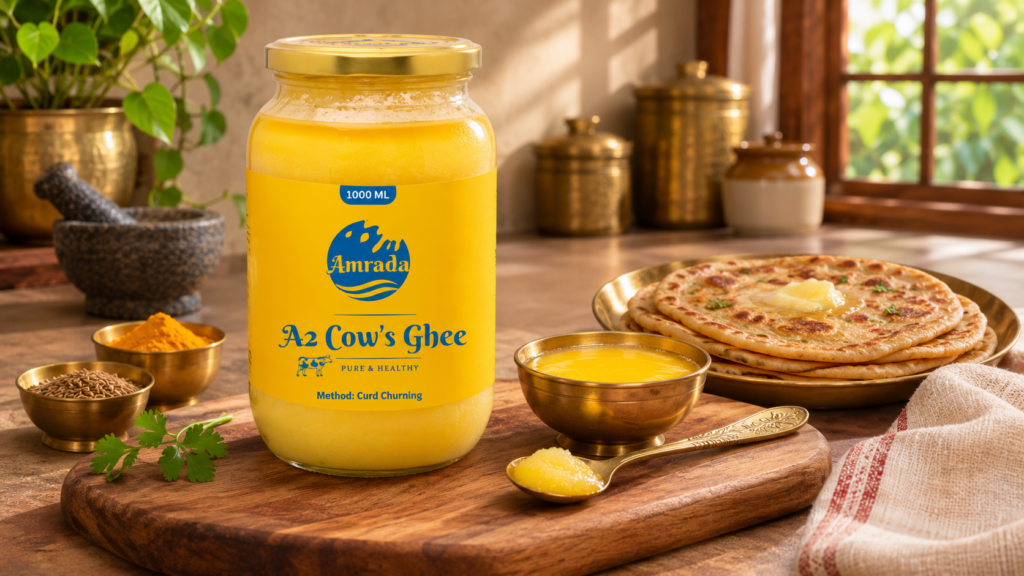
Choose a clean, food-grade container
The simplest container is often the original jar, provided it is intact, suitable for food storage and has a functioning lid. Glass allows you to see how much ghee remains and is easy to clean between uses. A compatible food-grade steel container can also be practical. If transferring ghee, wash and dry the new container completely before filling it, and avoid mixing an old, partially used batch with a fresh one unless a manufacturer specifically advises doing so.
Do not use an unlabelled container that previously held household chemicals, fragrance products or non-food oils. Check lids for cracks and damaged seals. When a container is difficult to clean thoroughly, replace it rather than trying to work around accumulated residue. A container’s appearance matters less than its suitability and hygiene. Keeping the original product label or recording the batch and best-before date is helpful when ghee is moved to a decorative kitchen jar.
Dry spoons are a small but important rule
A spoon that has just been rinsed may still carry water droplets. A spoon used to stir dal may carry food particles, salt or moisture. Putting either into the main jar introduces material that did not belong there. Reserve a clean, dry spoon for ghee, or pour a small measured quantity into a separate utensil before cooking. This becomes especially useful when several family members prepare meals at different times.
Avoid dipping rotis or bread directly into the shared container. If you want softened ghee for spreading, move a little into a separate clean bowl. Never pour unused ghee from a serving bowl back into the original jar. The main container should remain a storage vessel, not a common serving dish. These habits are easy to teach to children helping in the kitchen and can prevent unnecessary waste without adding extra equipment.
Cupboard or refrigerator: which is better?
There is no universal answer for every jar of cow ghee. The manufacturer may indicate storage in a cool, dry place away from sunlight and may provide instructions after opening. Follow those first. If your kitchen stays relatively cool and the label permits cupboard storage, an enclosed cabinet away from the stove, oven and window may be appropriate. If indoor temperatures become very high or the manufacturer recommends refrigeration, a properly cold refrigerator is a reasonable option.
Refrigeration can change the texture of ghee, making it firmer and less convenient to scoop. That change alone does not mean the product has spoiled. In warm weather, ghee may soften or liquefy, also without necessarily indicating contamination. The important difference is between ordinary physical changes and a product with off odours, foreign matter, damaged packaging or an unknown history. For general food-safety principles, the WHO’s five keys to safer food encourage appropriate storage temperatures and clean handling.
Keeping ghee away from a hot cooking zone
Many Indian kitchens store oil, salt, spices and ghee on a shelf immediately beside the gas stove because they are used daily. Convenience comes at a cost if a jar sits close to burner heat, steam and cooking splashes. Select a cupboard that stays comparatively cool, and put the jar away after measuring what you need. If you regularly prepare tadka, keep a small serving bowl near your cooking station rather than the entire stock jar.
Steam from a boiling saucepan may condense on nearby utensils, creating a moisture risk when those utensils are dipped into fat. Greasy cooking surfaces also accumulate dust and residues. Closing the jar immediately after use limits exposure. When the ghee becomes liquid in summer, do not mistake that change for a reason to leave the lid open or stir it repeatedly. A quiet storage location works better than constant handling.
Summer, monsoon and winter storage decisions
Indian homes experience varied conditions. A warm kitchen in June, a humid monsoon pantry and a cool winter cupboard are not identical environments. In summer, prioritize shade, distance from heat sources and any instructions about refrigerated storage. During the monsoon, concentrate on keeping water and damp utensils away from the jar. In winter, firm or grainy ghee may simply be responding to cooler temperatures.
You do not need to heat an entire jar to make it look smooth each time. If you require liquid ghee for a recipe, gently warm a measured portion rather than repeatedly warming and cooling the full container. Avoid placing a glass jar directly over a flame. If you use a warm-water bath for a sealed container, ensure no water enters the product and follow packaging safety instructions. A product’s intended storage and use instructions should always override kitchen folklore about seasonally perfect textures.
What happens when ghee turns grainy?
Ghee is a mixture of fats that may crystallize differently depending on temperature and handling. Some products develop a grainy or semi-solid appearance while others seem smooth. Texture can change after warming, cooling or being stored in a different part of the kitchen. These observations can help you understand the product’s physical character, but granulation is not a laboratory purity test and does not prove a particular traditional manufacturing method.
Similarly, yellow colour varies with the ingredients and process used. A deep yellow jar is not automatically safer, more nutritious or free from adulteration. When evaluating product quality, use documented ingredient information, established standards and specific supporting evidence. Amrada provides A2 Cow Ghee in a 500 ml pack and a 1000 ml A2 Ghee option, among other products. Consult the individual listing for variant-specific claims rather than treating colour as proof.
Do ghee jars need to be sterilized at home?
When transferring ghee, the goal is a container that is appropriately clean, food-safe and completely dry. Follow the container manufacturer’s cleaning guidance. Do not pour hot ghee into a glass jar that is not designed for thermal shock, because sudden temperature changes may damage it. Do not use rough cleaning chemicals that could leave harmful residues. If a jar is already filled and sealed by the producer, unnecessary transfer can introduce more contamination than it prevents.
It helps to keep a simple routine for refilling: finish one batch, clean the container, dry it fully, and only then add a new product. Avoid topping up a jar containing old crumbs or residue. The aim is to preserve the benefits of having a reliable, labelled product in the first place. For a household buying ghee frequently, a smaller daily-use container and a properly closed reserve pack can make sense only if both are handled hygienically.
Should you buy 500 ml or 1000 ml for storage convenience?
Smaller packs can be practical for households that use ghee occasionally or want to try a new range without storing a large quantity for months. A 1000 ml pack may suit frequent cooking and larger families. But the best size depends on actual consumption, the label’s dates and storage space. Do not choose the larger quantity solely because the unit price seems attractive if it will sit unused for too long.
Amrada lists both Premium Cow Ghee 500 ml and Premium Cow Ghee 1000 ml, alongside A2 variants. These are ghee offerings available for online purchase across India, subject to delivery serviceability. Check current prices and pack details on the live listings rather than relying on a blog price that may become outdated. A buyer in Chennai, Jaipur or Bengaluru should also verify delivery availability for their PIN code before checkout.
How long can a jar of ghee be used?
The useful life of a particular pack depends on its formulation, manufacturing conditions, packaging, storage and whether it has been opened. There is no responsible universal shelf-life claim that covers all ghee jars. Check the printed best-before or use-by information, and note any instructions regarding the period after opening. The difference between a quality date and a food-safety warning should not be ignored.
A product may become less pleasant before its labelled date if it has been exposed to heat, air or contamination. Conversely, the fact that a jar still smells acceptable after a date does not automatically justify continued use. Good household practice means keeping the label available, checking for a damaged seal when first opening, and rotating stock rather than forgetting older packs behind newer ones. Never describe ghee as something that remains safe forever because traditional households have stored it for long periods.
When to discard ghee rather than use it
An unusual rancid or paint-like odour, obvious foreign matter, mould-like growth, unexplained contamination or a seriously damaged container are reasons not to use a product. Do not taste suspicious ghee simply to check its safety. A change from semi-solid to liquid in warmer weather is not equivalent to these warning signs, but it should prompt you to check whether the storage location is appropriate.
If a jar has been accidentally filled with water, touched by a dirty serving spoon or left uncovered near food splashes, assess the contamination risk conservatively. Reheating the entire jar is not a guaranteed solution. The safest option for a compromised product may be disposal, particularly when it will be served to people vulnerable to foodborne illness. A small amount of wasted fat is less important than avoidable exposure to an uncertain product.
Everyday kitchen uses and sensible portions
Ghee is useful in Indian dishes because it adds a distinctive aroma and a rich finish. A little can enhance the flavour of dal, khichdi, vegetables, rotis and traditional sweets. It is still a concentrated cooking fat with saturated fat, so the quantity matters. There is no need to describe each spoonful as a supplement or a way to cure digestion, heart or immunity problems.
The ICMR-NIN Dietary Guidelines for Indians encourage balanced dietary patterns and attention to fats and oils. For practical cooking, measure the amount needed instead of repeatedly adding extra ghee for a stronger aroma. A good quality product can be appreciated for taste, texture and culinary tradition while remaining one part of an overall varied diet.
How to check online ghee information before buying?
A transparent product page should clearly identify the variety, net volume, ingredient and handling information, seller details, and current delivery arrangements. If a brand mentions testing, check the actual report and the parameters it covers rather than assuming that one report proves every possible quality claim. A description of a method used for one SKU should not automatically be applied to every other variant.
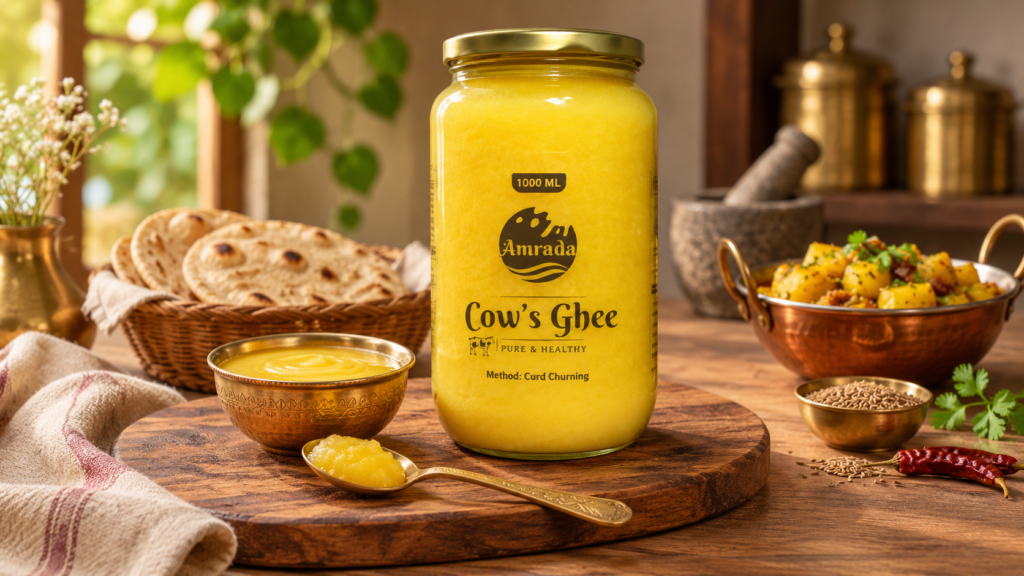
For a Dehradun-based producer such as Amrada, the cow ghee collection gives buyers a starting point for comparing available sizes. Those looking for information about the business and its associated farm can consult About Amrada, while available supporting documents may be reviewed on the awards and certificates page. When a statement matters to your purchase decision, prefer documentation over phrases such as “miracle food” or “chemical-free forever”.
Common storage mistakes
| Habit | Why it can be a problem | Better option |
| Wet spoon in jar | Adds moisture and residue | Use a clean dry spoon |
| Jar beside burner | Increased heat and splashes | Choose a cooler enclosed location |
| Loose lid | More air and contamination opportunities | Close tightly after each use |
| Mixing old and new ghee | Loses batch and date clarity | Finish, clean and dry first |
| Storing without label | Forgets origin and best-before date | Retain label or record details |
| Repeated heating of full jar | Unnecessary handling | Warm only the portion needed |
Frequently asked questions
Does cow ghee need refrigeration in India?
It depends on the product label, packaging and household conditions. Some shelf-stable ghee is intended for cool, dry cupboard storage; follow the manufacturer’s directions and adapt to extreme heat when appropriate.
Why does ghee become liquid in summer?
Its fat crystals respond to temperature. Liquefying can be a normal physical change and does not alone prove spoilage.
Is grainy ghee automatically pure?
No. Granulation is not an independent purity or production-method test. Use reliable labelling and evidence when evaluating claims.
Can I put a wet spoon in ghee?
Avoid it. Use a clean, completely dry spoon to reduce moisture and food-residue contamination.
How long does ghee last after opening?
Check the specific jar’s date and instructions. Storage history and packaging vary too much for one universal answer.
Can I heat a whole jar to remove grains?
Unnecessary repeated heating is best avoided. If a recipe needs liquid fat, gently warm a measured portion in appropriate cookware.
Does Amrada deliver ghee outside Uttarakhand?
Yes. Amrada lists A2 and Premium Cow Ghee for ordering across India, subject to serviceability and current checkout terms.
Conclusion
Store cow ghee in a closed, clean container, use dry utensils and avoid sunlight, steam and excessive heat. Follow the directions on the exact product, use an appropriate pack size and treat texture changes differently from signs of contamination. For shoppers comparing A2 and Premium Cow Ghee, Amrada’s online ghee range offers 500 ml and 1000 ml options. Review the current product information before ordering and keep the jar carefully once it reaches your kitchen.